Artificers are exceedingly rare in the Moonshae Isles. A player who wishes to play one should create a background explaining what drew their character from another homeland to the isles.
If you are an artificer with knowledge of the Moonshae Isles, you know this is a land where magic is usually older, holier, and less mechanical than your own craft. That makes the isles both difficult and fascinating: a place where forged tools, enchanted objects, practical ingenuity, and experimental magic meet sacred springs, ancient woods, and a population that may admire your work or eye it like a suspicious crab.
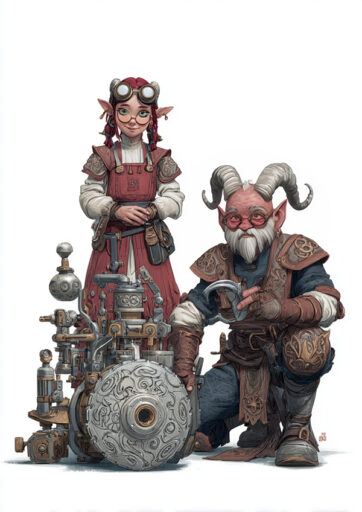
What You’ve Heard of the Moonshae Isles
- The Moonshae Isles are known for rugged coasts, old kingdoms, sacred natural power, and a culture shaped more by druids, rulers, and seafarers than by inventors’ guilds or arcane workshops.
- Artificers hear that the isles have real mining, metalwork, trade, and high-quality weapons, but that their magical reputation comes more from the land itself than from crafted devices.
- Even outsiders tend to know the Moonshaes are the sort of place where a clever tool may be welcomed, but anything too strange or intrusive risks being judged against older local traditions. This last point is an inference from the setting’s strong sacred and customary culture.
The People You Understand Best
- Artificers tend to understand smiths, miners, shipwrights, armorers, stonemasons, alchemists, and practical craftspeople who solve problems with labor, skill, and material knowledge.
- The dwarves of the isles would make immediate sense to many artificers, since the Moonshaes include dwarven communities and mining traditions alongside human rule.
- The Northlanders also make sense in a practical way, because seafaring cultures respect sturdy gear, repair skill, and anyone who can keep vital things working when the weather gets theatrical. That final point is an inference from their maritime culture.
Powers, Faiths, or Traditions That Matter to You
- An artificer in the Moonshaes learns quickly that local people care deeply about the sacred character of the land, and that crafted magic is often judged by whether it supports or disrupts that older order. This is an inference from the centrality of sacred natural traditions in Moonshae lore.
- Gond may matter more to artificers than to most classes, since he is the Realms’ god of craft, smithwork, invention, and inspired making; a Gond-minded artificer would see the Moonshaes as a place ripe for practical wonders, if approached carefully.
- Artificers would also pay attention to the tension between durable craft and living magic here: a fine blade, a clever charm, or an enchanted tool fits the setting more naturally than anything that feels like it is trying to out-argue the land itself. That is an inference from the Moonshaes’ magical character.
Important Factions, Orders, and Influential Figures
- The Kendrick rulers matter because stable rule affects trade, roads, ports, mining, and whether ambitious craftwork gets patronage or smashed during the next crisis.
- Dwarven clans and craftspeople matter to artificers because they represent the strongest obvious tradition of skilled fabrication and subterranean resource-work in the isles.
- The druids of the Earthmother matter too, because no artificer working in the Moonshaes can afford to ignore the people who guard its most sacred places and oldest sources of power. This is an inference strongly supported by the setting’s religious structure.
Why People Like You Are Needed Here
- The Moonshaes need artificers because hard islands need good tools, sound repairs, sturdy ships, reliable gear, and enchantments that solve practical problems instead of making speeches.
- Artificers are especially useful where frontier conditions meet real danger: damaged fortifications, failing equipment, difficult travel, scarce resources, and communities too remote to wait for help. This is a class-based inference that fits the setting’s geography and politics.
- In a land known more for primal power than crafted magic, artificers bring a different kind of intelligence: one that builds, adapts, reinforces, and occasionally keeps everyone alive through sheer stubborn competence.
[reveal_character_details]
Places Your Kind Talks About
- Artificers talk about mines, forges, docks, workshops, strongholds, and trade centers more than sacred groves or royal poetry recitals.
- Caer Callidyrr would matter because it is a major political and trade center, and places of concentrated wealth are where fine work and useful devices are most likely to find patrons.
- Dwarven settlements, mountain regions, and ports matter just as much, since raw materials, metalwork, and maritime repair are the kind of things your people actually gossip about on purpose.
Dangers, Enemies, and Bad Omens
- Artificers fear failing infrastructure almost as much as monsters: cracked walls, rotten hulls, spoiled stores, snapped fittings, and any local lord who thinks maintenance is a personality flaw.
- The Moonshaes add worse threats, including raiders, storms, corrupted lands, and supernatural forces that can twist crafted things along with living ones. This is partly inference from the broader danger profile of the isles.
- A bad omen for an artificer is any place where tools rust too fast, fire burns wrong, metal sings strangely, or skilled locals quietly refuse to work near a site after dusk.
Rumors, Sayings, and Half-Truths You’ve Picked Up
- “A broken charm is a warning; a broken hinge is a confession.” That sounds exactly like the sort of thing a Moonshae craftsperson would mutter before charging extra.
- “The isles like good steel, but not clever arrogance.” That is not a canonical saying, but it fits the Moonshaes’ general dislike of people who mistake skill for dominion.
- “Build against the storm, not against the land.” An artificer in the Moonshaes learns quickly that nature here is not a design flaw.